Category: Government

  • Monroe Sets Deadline to Fill At-Large Council Seat After Mayoral Shift

    Monroe Sets Deadline to Fill At-Large Council Seat After Mayoral Shift

    The City of Monroe is moving forward with plans to fill a vacancy on its Common Council, setting a May 26 deadline for interested residents to submit nomination papers for the open at-large alderperson seat.

    The vacancy was created after former Alder Tom Miller was elected mayor, leaving the citywide position open.

    At its April 21 meeting, the Common Council outlined the process to appoint a replacement, encouraging eligible residents to step forward and serve. Candidates must gather at least 50 signatures from Monroe residents as part of the nomination process.

    City officials say the council will review all submitted materials and plans to vote on an appointment in June. The individual selected will serve the remainder of the current term, which runs through mid-April 2027.

    Those appointed will also have the option to run for a full term in the spring 2027 election, when the seat returns to the ballot for a citywide vote.

    Nomination papers are available through the City Clerk’s Office, with digital packets posted on the city’s website. Residents with questions can contact City Clerk Nikolai Wahl at City Hall.

    The at-large alderperson represents the entire city, making the role a key voice on issues affecting the broader Monroe community.

  • Green County Addresses Tax Impact as Jail Project Moves Ahead

    Green County Addresses Tax Impact as Jail Project Moves Ahead

    Green County officials are offering new details on the potential tax impact of a planned jail and law enforcement center as the project continues to move forward.

    The County Board of Supervisors previously approved borrowing up to $86.1 million for the project in June 2025. More recently, at its March meeting, the board authorized a contract with Kraemer Brothers to handle construction and project management, clearing the way for work to proceed.

    With the project advancing, county leaders say they’ve heard increasing questions from residents about how the debt will affect property taxes. In response, the county released a public statement outlining what is known and what remains uncertain.

    Officials emphasize that several variables will ultimately determine the impact on individual tax bills, including the final borrowing amount, interest rates, property values, and local and county mill rates. Ongoing efforts to secure grants could also reduce the amount of debt needed.

    Based on estimates presented to the County Board last June by PFM Financial Advisors, the county’s share of the mill rate could increase by about $1 once the full debt is reflected on tax bills in 2028. However, officials caution that figure may change as conditions evolve.

    County leaders say minimizing the financial impact on residents remains a top priority as the project progresses.

  • Green County Names First-Ever Administrator Following Board Approval

    Green County Names First-Ever Administrator Following Board Approval

    Green County has selected its first county administrator, with the County Board of Supervisors confirming Nicholas Owen to the newly created leadership role during its Feb. 10 meeting.

    The appointment marks a significant step in the county’s transition to a county administrator form of government, where the position will serve as the chief administrative officer overseeing day-to-day operations and implementing board policies.

    County Board Chairperson Jerry Guth announced the decision, noting Owen emerged from a competitive field of 39 applicants following what officials described as a thorough recruitment and assessment process. The search, led by the county’s Personnel and Labor Relations Committee, included interviews, stakeholder input, and a two-day final evaluation earlier this month.

    Owen brings more than 20 years of local government experience to the role. He has served as village administrator in Mount Horeb since 2015, managing a $27 million annual budget and overseeing major capital projects. Before that, he held the same position in New Glarus from 2006 to 2015.

    He holds a master’s degree in public administration from the University of Wisconsin–Milwaukee and a bachelor’s degree in public administration from the University of Wisconsin–Stevens Point.

    Guth said the board is confident Owen’s leadership style and experience align with the county’s priorities as it moves forward under the new structure.

    The administrator position was created as part of broader organizational changes aimed at strengthening coordination across departments and improving overall operations.

    Green County officials said Owen is expected to begin his new role later this spring, pending completion of standard pre-employment requirements.

  • Gov. Evers Announces 20 Wisconsin School Districts to be Awarded Fab Lab Grants in Celebration of “Fab Lab Day”

    Gov. Evers Announces 20 Wisconsin School Districts to be Awarded Fab Lab Grants in Celebration of “Fab Lab Day”

    MADISON — Gov. Tony Evers today, in celebration of “Fab Lab Day”, together with the Wisconsin Economic Development Corporation (WEDC), announced nearly $500,000 in grants to 20 Wisconsin school districts to train students in science, technology, engineering, arts, and mathematics (STEAM) skills and prepare them for careers using advanced technologies through establishing or expanding local fabrication laboratory (fab lab) facilities.  

    This announcement comes as Gov. Evers declared 2025 the Year of the Kid and introduced the most pro-kid budget of any governor and any budget in state history. Gov. Evers’ 2025-27 Executive Budget will make the largest direct investment in state general school aids in 30 years, with more than $3.1 billion in general and categorical aids for K-12 public schools statewide. Additionally, Gov. Evers’ budget proposes a $140 million investment to continue the successful Workforce Innovation Grant Program. To date, Gov. Evers has directed more than $128 million to 27 projects supporting locally driven workforce solutions statewide, including opportunities for youth and students across the state to develop critical workforce skills, such as those in advanced manufacturing and other in-demand fields.

    “During the Year of the Kid, it’s more important than ever to invest in the future of Wisconsin’s kids and give them every opportunity to develop valuable skills that they can use to become the leaders and innovators tomorrow,” said Gov. Evers. “Thanks to our partners at WEDC, school districts across the state will be able to equip their students with state-of-the-art laboratories for learning, ensuring our kids have the education and resources necessary to become the workforce of tomorrow.” 

    A fabrication laboratory, or Fab Lab, is a high-technology workshop equipped with computer-controlled manufacturing components such as 3D printers, laser engravers, computer numerical control routers, and plasma cutters. Through the Fab Lab Grant Program, WEDC is supporting the purchase of fab lab equipment for instructional and educational purposes for K-12 students across the state. 

    “WEDC has invested over $5.5 million over the past ten years to provide 133 schools across the state with the equipment necessary to help students learn high-demand skills, including technology, manufacturing, and engineering,” said WEDC Secretary and CEO Missy Hughes. “Fab Labs benefit not only the students themselves with important technology and career skills, but they also benefit Wisconsin employers, who will be able to find workers with the right skills to allow their companies to grow and thrive.”

    A total of $497,199 in Fab Lab Grants from WEDC will be distributed to 20 public school districts across the state. Individual school districts were eligible for grants of up to $25,000, and consortiums of two or more districts were eligible for up to $50,000. The program requires matching funds from each district.

    The following school districts were awarded Fab Lab Grants:   

    • Elkhorn Area School District | $25,000
    • School District of Nekoosa | $24,847
    • DeForest Area School District | $25,000
    • Albany School District | $25,000
    • School District of Belleville | $14,824
    • Nicolet Union High School District | $25,000
    • Joint School District 1/Benton School District | $16,936
    • School District of Arcadia | $25,000
    • Alma Area Schools | $25,000
    • CESA 3 (consortium) | $49,872
    • North Crawford School District | $24,856
    • Weyauwega-Fremont School District | $20,000
    • Luck School District | $25,000
    • Muskego-Norway Schools | $21,688
    • Whitnall School District | $25,000
    • Tri-County Area School District | $25,000
    • School District of Monroe | $25,000
    • Ellsworth Community School District | $25,000
    • Westosha Central High School District | $25,000
    • Pewaukee School District | $24,176 

    WEDC received 29 total applications for Fab Lab Grants. The grants were awarded on a first-come, first-served basis, with applications evaluated based on readiness and long-range planning, curriculum, business and community partnerships, financial need, and previous awards. 

    In addition to the grants, WEDC and the University of Wisconsin-Stout developed a Fab Lab resource page that provides districts with information on how to set up and equip a Fab Lab, how to implement best practices to ensure a successful Fab Lab, and more.  

    For more information on the state’s Fab Labs, including resources for teachers, visit wedc.org/fablabs

  • Approaching learning in Monroe in a new way

    Approaching learning in Monroe in a new way

    MONROE, WI. MAY 1, 2025 – Students in Monroe will learn to use state-of-the-art technology while also testing their entrepreneurial skills with the help of two grants from the Wisconsin Economic Development Corporation (WEDC).

    The School District of Monroe and Green County Development Corporation (GCDC) are teaming up approach education in a new way.

    “We’re trying to find ways to give kids the opportunity to have hands-on learning and try new things,” said Olivia Otte, executive director of Green County Development Corporation.

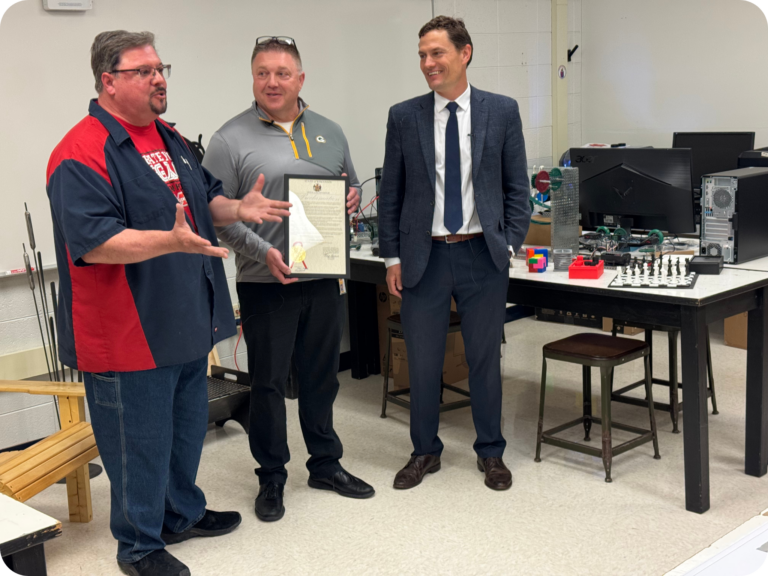
    During a visit to Monroe High School Thursday, WEDC Deputy Secretary and COO Sam Rikkers was able to see some of the equipment the Fab Lab Grant had already purchased and to hear about GCDC’s plans for a youth entrepreneurship program that will be funded with a Small Business Development Grant (SBDG).

    “This is a fabulous example of how schools and local and state economic development organizations can work together to prepare the next generation of Wisconsin workers,” Rikkers said. “These students are getting exposed to the technology being used in today’s jobs, but also will learn what it takes to thrive as an entrepreneur.”

    A $25,000 Fab Lab Grant will allow the Monroe School District to replace old, outdated equipment with new, state-of-the-art equipment that will advance architecture, engineering, and construction studies with computer design and physical prototyping. Students will be able to creatively solve real-world needs– from concept to prototype.

    “This new equipment will enable our students to become more proficient in computer-aided design and development while learning the industry-standard software programs that we teach,” said Chuck Lynch, technology and engineering teacher at Monroe High School. “Students will create physical prototypes of their design solutions, using a variety of materials and methods, in order to better evaluate and improve their designs.”

    The equipment in the Fab Lab will also be integrated into classes at Monroe High School, including the LAUNCH programming—a collaborative classroom experience featuring project-based learning to solve real-world problems in the community—and other computer and technology education classes.

    The district is building a new high school, which is expected to open for the 2026-2027 school year. Lynch said the new building will include specialized learning areas for the equipment, but students will still get to begin to learn on the equipment this fall.

    “This will remove many of our current barriers to learning,” Lynch said. “We will no longer be hindered by the outdated and inadequate equipment, which made learning more limited and difficult.”

    While the Fab Lab Grant will provide students with the opportunity for hands-on learning with state-of-the-art technology, another WEDC grant will help those who have visions of opening their own businesses.

    GCDC received a $60,000 Small Business Development Grant which they’ll use to launch a two-part initiative to promote entrepreneurship and provide long-term support for small businesses.

    GCDC is collaborating with the school district on the Youth Entrepreneur Program, which is designed to inspire and support student entrepreneurs.

    “We want the kids to try things and for this to be a safe place for kids to fail at starting a business as well,” Otte said. “We want them to see failure as, ‘OK, I tried something and it didn’t work. What’s my next step going to be?’”

    The program will include interactive workshops where students learn the basics of starting and running a business. There will also be a hands-on component where students are given $50 and two weeks to make as much money as they can with their business idea.

    GDCD will work with community partners, including 4-H, FFA, and business teachers in high schools, to identify potential students to participate in the program. Students at schools throughout Green County will be eligible to participate in the program.

    “We see this grant as a retention tool for the youth in our community because we understand that not everybody should, or can, go to a four-year university after high school,” Otte said. “We want high school students to recognize that one of the career options is starting your own business and we know that a lot of times high schoolers are more creative and more willing to take risks than adults.”

    The second prong of GCDC’s initiative is a microloan program that will provide small business owners up to $10,000 at 0% interest. These will focus on traditionally underserved entrepreneurs.

    Before visiting the high school, Rikkers visited downtown Monroe where he was updated on a pocket park and the White Block Building. The WEDC assisted with the projects with Vibrant Spaces and Community Development Investment grants.